

by Edentu Oroso, Publications Unit
The Dean, Faculty of Humanities and Social Sciences, Federal University Otuoke, FUO, Prof. Osakue S. Omoera, has called for increased investment in Nigeria’s humanities and creative industries, saying the sectors hold enormous potential for job creation, wealth generation, education and global visibility.
Professor Omoera made the call on Wednesday, September 23, 2026, while delivering a lecture titled “Edutainment Potentials of the Humanities in Global Attention Economy” at the Maiden Public Lecture Series of the School of Postgraduate Studies, Federal University Otuoke.
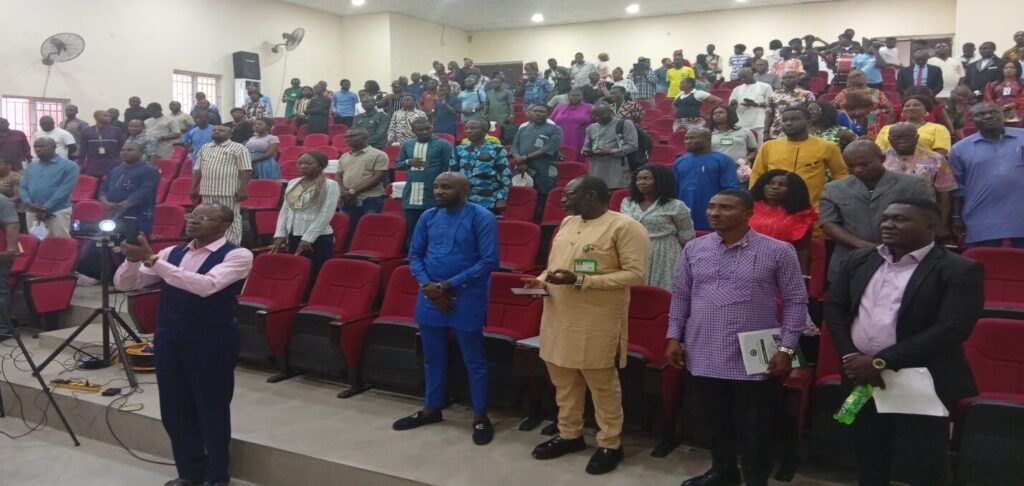
The lecture, held at the Auditorium of the Postgraduate School, West Campus, focused on the growing role of culture, creativity and innovation in economic transformation and the projection of African identity on the global stage.
Professor Omoera said the 21st century had witnessed a growing recognition of the cultural and creative industries as important drivers of economic development, social cohesion and global diplomacy.
He noted that Africa’s rich artistic traditions, cultural practices and creative expressions, which had for decades been undervalued, could provide a strong foundation for sustainable and inclusive development if properly harnessed.
According to him, Africa’s creative economy is already a booming sector valued at over $50 billion, with millions of young people earning livelihoods from different aspects of the industry.
He said the creative industries were increasingly becoming important sources of employment, in some cases outpacing traditional sectors such as manufacturing in job creation.
The don also noted that the sector was projected to account for up to 10 per cent of global creative goods exports by the end of the decade, while initiatives such as the Afreximbank Creative Africa Nexus, CANEX, were expanding financing opportunities for creative businesses.
Professor Omoera argued that the humanities should no longer be viewed merely as academic disciplines but as strategic instruments for economic and social development.
He said arts and culture could function both as a mirror of society and as a catalyst for transforming it.
He observed that although considerable attention had been devoted to economics, political science and health within global development discourse, the humanistic and cultural dimensions of development had often been overlooked.
He therefore called for the humanities and creative industries to be integrated more deliberately into development strategies, stating that “African arts and culture are not peripheral embellishments to development discourse but central instruments for rethinking how societies flourish…”
The professor identified music, film and animation, fashion and costume design, digital gaming, stand-up comedy, spoken-word art, creative writing, dance, visual arts, community theatre and comics as some of the sectors capable of driving growth.
He said African musicians were using digital streaming platforms to reach audiences across the world, while music was also being deployed to simplify complex subjects such as public health, civic responsibilities and financial literacy.
Beyond entertainment, he said contemporary music could help preserve indigenous languages, oral traditions and historical knowledge for younger generations.
On the Nigerian film industry, Professor Omoera cited Nollywood as a major contributor to the creative economy, generating about $590 million annually.
He also pointed to the growing international visibility of African fashion through events such as Lagos Fashion Week.
The lecturer further identified digital gaming as an emerging area of opportunity, noting that Africa’s video game market reached $1 billion in 2024.
He said African game developers were increasingly incorporating indigenous history, folklore and strategic thinking into digital games, while mobile games were also being used to make school curricula more engaging.
According to him, such applications of technology demonstrate the potential of edutainment, the combination of education and entertainment, as a tool for knowledge transmission and cultural preservation.
Despite the opportunities, Professor Omoera identified inadequate funding, weak enforcement of intellectual-property laws and poor infrastructure as major challenges confronting Nigeria’s humanistic and creative sectors.
He said many creators still found it difficult to obtain loans and investment from traditional financial institutions.
He also noted that inadequate enforcement of laws protecting original ideas and creative works continued to expose practitioners to significant challenges, while poor infrastructure limited the capacity of the industry to achieve its full potential.
The university don called on government agencies, financial institutions and technology companies to develop strategic partnerships with creative practitioners and innovators.
He specifically mentioned the Nigerian Content Development and Monitoring Board, NCDMB, Nigerian Deposit Insurance Corporation, NDIC and fintech companies including Opay, Interswitch, Flutterwave and Moniepoint.
Professor Omoera said such institutions could support the creative sector through funding, partnerships and initiatives designed to help Nigerian artistic and cultural products penetrate international markets.
He further cited projections that the global arts and culture sector could reach $200 billion by 2030, stressing the need for Nigeria to position its creative industries to benefit from the anticipated expansion.
He urged policymakers, academics and other stakeholders to rethink the place of the humanities in national development, arguing that the sector could become a major engine of employment, wealth creation, education and Nigeria’s cultural diplomacy if given the necessary institutional and financial support.
The lecture formed part of the Maiden Public Lecture Series organised by the School of Postgraduate Studies, Federal University Otuoke, as the institution continues to promote scholarly engagement on contemporary national and global issues.